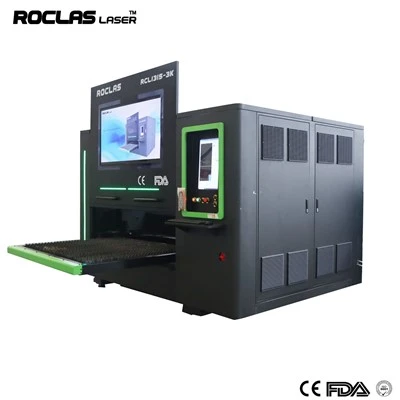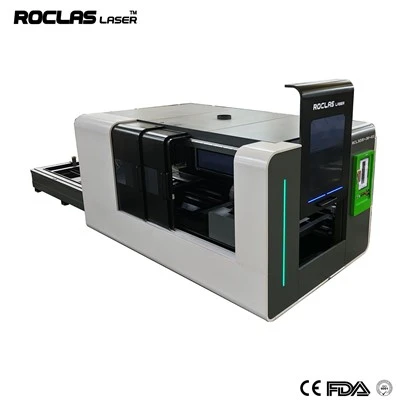


Roclas Laser Technology is one of the leading manufacturers and suppliers of metal cutter fiber laser cutting machine in China, featured by quality products and good price. Please rest assured to buy discount metal cutter fiber laser cutting machine for sale here from our factory.
Product Definition
The enclosed dual-pallet shuttle-type fiber-laser metal processor belongs to planar sheet-focused CNC metal fabrication hardware, distinctly separated from 5-axis three-dimensional processing equipment and dedicated tubular profile laser cutters. Instead of raising output purely by boosting laser wattage, this platform tackles one major pain point of traditional flat-sheet laser processing: non-productive downtime caused by sheet replacement, part sorting and scrap clearance.
It leverages fiber-delivered high-density photon energy to locally melt or vaporize flat metallic blanks; pressurized process gas evacuates molten residues to form precise planar kerfs. Its core mechanical innovation lies in the motor-driven shuttle pallet system: cutting execution and manual material preparation are physically decoupled into two independent spatial zones. Operators conduct loading-unloading work outside the sealed cutting enclosure without halting laser operation. Targeted at job-shop subcontractors and multi-shift fabricators, this equipment balances continuous uptime, operator occupational safety, energy consumption and part consistency. Different from CO₂ laser solutions, fiber-beam transmission eliminates complex mirror-adjustment workflows and cuts long-term maintenance overhead for day-to-day sheet-metal production.
Applied Industries
ROCLAS RCL shuttle-pallet fiber-laser portfolio delivers diversified footprint and power combinations, oriented exclusively toward flat metal sheet jobs (not built-in rotary axis for tubes or multi-angle rotary heads for 3-D curved parts). Custom travel dimensions, enclosure grades and shuttle-pallet load ratings are supported for special-condition workshops.
RCL-3015-S
(Featured model for this page)
Processing footprint: 3000 × 1500 mm; laser power tier: 3 kW-20 kW. Optimized for standard-size commercial metal sheets; best-fit for mixed-SKU subcontract workshops and medium-batch job-lot production. Shuttle pallet rated load: up to 3 tons.
RCL-4020-S
Processing footprint:4000 × 2000 mm; laser power:3-20 kW. Developed for oversize sheet blanks, cabinet panels and large structural flat components. Higher-load shuttle pallets available as an upgrade option.
RCL-6020-S / RCL-6025-S
Processing footprint:6000 × 2000 mm /6000 × 2500 mm; laser power:6-20 kW. Tailored for heavy-gauge plate and non-stop two-/three-shift factory-floor operation, for users prioritizing large-format continuous throughput.
- Optional derivative setups: partial-open safety housing or full-grade enclosed cabin; expandable auxiliary modules include heavy-duty scrap-removal conveyor, multi-station gas manifold system and enhanced smoke-filtration assembly. All series adopt unified software kernel, but shuttle-exchange speed and pallet locking mechanism parameters are tuned respectively according to table dimension and load capacity.
Selection Criteria
Selecting a shuttle-pallet fiber-laser unit cannot rely merely on sheet dimension or laser power figures. Buyers need to evaluate workflow-related economic indicators and workshop boundary conditions, to avoid over-investment or insufficient matching between machine capability and actual order mix.
Compare your average cutting time per nested sheet versus manual handling duration (unloading finished parts, scrap separation, new sheet positioning). The shuttle-table solution delivers obvious return only when material-prep work can be finished while another pallet is undergoing cutting. If most of your jobs feature extremely long single-nest cutting cycles, a single-table configuration may deliver better capital efficiency.
Apart from blank length & width, confirm actual sheet weight. Thick heavy plates impose higher demands on shuttle-pallet rigidity, locking accuracy and exchange-drive motor performance. Overlooking pallet load rating will trigger positioning drift after long-term heavy-plate operation.
Distinguish theoretical maximum cutting thickness from commercially viable processing thickness. Non-ferrous materials such as aluminum and copper require stable beam-management performance. Define your target edge quality: oxide-bearing low-cost cutting versus bright oxide-free finish, which determines your auxiliary-gas investment for daily running.
Shuttle-table design creates highest added value under double-shift or round-the-clock production. For intermittent, prototype-oriented low-utilization workshops, the efficiency improvement potential of dual-pallet hardware cannot fully offset its extra procurement cost.
Reserve sufficient lateral floor clearance for shuttle-pallet travel stroke; check ground bearing capacity for heavy-pallet switching movements. Verify three-phase power capacity, voltage-stabilizing requirement, humidity-condensation risk and reserved space for enclosure door opening and routine component replacement. Match grid voltage & frequency (50 Hz /60 Hz) to local infrastructure.
Calculate cumulative expenditure covering power draw, gas consumption, wearable spare-parts consumption, labor for maintenance and warranty coverage. Confirm whether you will possibly switch toward heavier-gauge plates in future years, to judge whether you need to reserve hardware upgrade margin for laser source or drive components.
Core Advantages
Cycle-overlap workflow reduces machine idle ratio instead of only raising cutting speed:Most laser equipment pursues faster traverse speed; this shuttle-pallet setup focuses on shrinking waiting gaps between batches. While one pallet runs cutting tasks inside the enclosed cabin, operators complete sorting, part collection and new-sheet positioning on the outer station. The machine does not halt for sheet swap, directly lifting overall equipment effectiveness (OEE). It is worth noting that actual efficiency gain depends on your on-site material-handling rhythm, rather than reaching fixed-value promotion under all production scenarios.
Enclosed partition design separates human-operation zone from high-energy processing zone:Physical isolation brought by full enclosure avoids operators approaching spark splash, stray laser light and high-temperature cutting area during running cycles. It lowers occupational-hazard risks compared with open-frame single-table machines. Smoke-extraction interfaces built into the cabin frame concentrate fume capture effect, improving local air quality inside metal-fabrication workshops.
Optimized bed-frame system oriented toward repeated pallet-switch impact load: Beyond standard welding and stress-relief treatment for laser machine bases, this series reinforces structural rigidity for frequent shuttle switching shocks. Pallet locking mechanism adopts multi-point positioning to offset positioning deviation generated from thousands-of-times table-swap cycles, sustaining long-run dimensional consistency under continuous-shift production.
Modular gas-supply architecture lowers trial-and-error cost for mixed-material orders :Multi-pressure auxiliary-gas manifold supports fast switching among compressed air, oxygen and nitrogen. Users can store multiple-gas pipelines simultaneously, without manual hose-replacement when switching between carbon-steel, stainless-steel and non-ferrous jobs. It shortens recipe-switching preparation time for multi-variety order-mix workshops.
Intelligent process database reducing operator-skill dependency: The embedded CNC system stores massive validated cutting recipes categorized by material grade, thickness and gas type. It supports automatic edge-seeking, pierce-logic adjustment and fault log recording. New-comer operators can launch qualified production after short-period training, lowering human-error risks for subcontract factories with frequent staff turnover.
Clear functional boundary for future-oriented modular expansion: The platform is specially designed for planar sheet processing (not for retrofitting into tube-cutting or five-axis 3-D cutting). Still, it reserves interfaces for upgrading laser power, adding high-efficiency smoke-filtration units and installing automatic sheet-loading auxiliary attachments, so users can expand processing capability step-by-step along flat-sheet-fabrication business growth.
Performance & Application
Key Processing Performance Metrics
-
Positioning accuracy: ±0.03 mm per meter; repeat-positioning precision: ±0.02 mm per meter.
-
Maximum rapid-traverse velocity: 80 000 mm/min; stable dynamic acceleration-deceleration control for high-speed planar contour cutting.
-
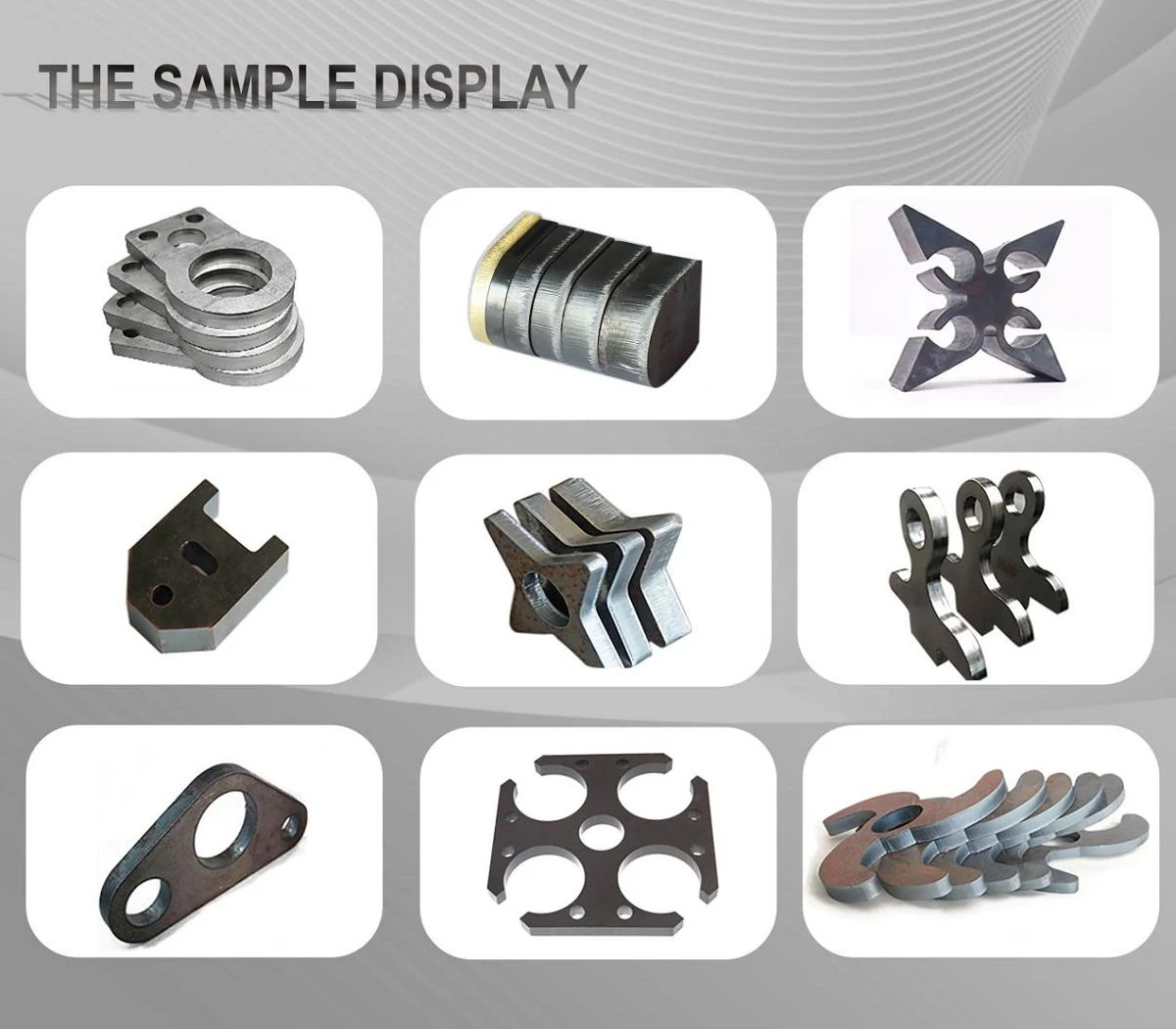
Processable workpieces: flat-format carbon steel, stainless steel, alloy steel, galvanized sheet, aluminum alloy, brass and other metal plates; it is not suitable for curved three-dimensional components or long tubular profiles (select ROCLAS 5-axis or tube-laser series for those requirements).
-
Supported auxiliary process gases: compressed air, oxygen, nitrogen; adjustable working pressure:0.6-0.8 MPa.
-
Ambient working prerequisites: environment temperature 0-40℃, relative humidity ≤80%, strictly prohibit dew-condensation phenomenon inside cabinet.
-
Continuous-running characteristic: designed for multi-shift non-stop industrial planar-sheet fabrication. Narrow cutting kerf and limited heat-affected zone; most flat parts obtain smooth cutting section, minimizing secondary polishing workload.

Typical Industry-Application Scenarios

Subcontract sheet-metal job-shops:Batch blanking for subsequent bending, stamping, welding and assembling procedures; coping with frequent-changing customer drawing orders.
General-purpose machinery manufacturers: sFlat structural brackets, equipment cabinet panels, base-plate components for various industrial installations.
Hardware and cabinet-accessory factories: Blank cutting for cabinet housings, metal fittings and decorative flat parts for post-processing forming.
Automotive-supply supporting enterprises: Flat-shaped custom metal components for vehicle assembly; excludes complex 3-D stamped-part trimming (5-axis model recommended for such work).
Sign-making and architectural-decoration vendors: Flat-pattern metal logos, decorative panels and building-facade metal flat ornaments.
Research laboratories and vocational-education institutions: Flat-metal-material process research, teaching demonstration of planar laser-cutting principles.
Elevator, household-appliance and agricultural-equipment suppliers: Mass-volume production of cabinet shells and large-size flat metal panels.

Core Configuration, Quality, Manufacturing & Service
Core-Component Selection Options
Fiber-laser source: MAX / Raycus / IPG generator modules (3 kW-20 kW power range optional).
Laser cutting head: RAYTOOLS or BOCI auto-focus assembly equipped with anti-collision sensing module.
Control unit: dedicated industrial-grade laser-cutting CNC controller, compatible with CAD-format drawing import and nesting-software data linkage.
Shuttle-pallet work-table: heavy-load blade-type dual-shuttle pallet; customized dimension and enhanced load-bearing version available upon demand.
Motion-transmission assembly: high-precision linear guide rails, rack-pinion sets and closed-loop servo-motor groups to guarantee high-speed stable planar movement.
Cooling system: industrial-purpose water chiller matched for constant-temperature laser-source thermal management.
Multi-channel gas-circuit assembly: integrated manifold supporting rapid switch-over for oxygen, nitrogen and compressed-air supply.
Manufacturing & Quality-Assurance System
Each ROCLAS shuttle-table fiber-laser unit goes through multi-phase strict quality-control workflow:
incoming-raw-material inspection
bed-body welding plus stress-relief aging
five-face high-precision milling
mechanical assembly of shuttle-exchange mechanism
complete-machine 72-hours continuous-running burn-in test
positioning-accuracy calibration
real-material cutting-sample verification before ex-factory shipment
Products obtain CE and ISO 9001 certification. For customized-spec machines with higher-load pallets, extra shuttle-switch durability testing will be completed before delivery.
Warranty & Global-Scope Service Framework
Warranty packages
12-60-month optional coverage according to signed-contract terms; original laser source follows component-manufacturer global-warranty clauses.
Pre-sales technical support
free real-sample cutting trial based on your actual blanks; production-cycle simulation analysis for evaluating shuttle-table ROI.
After-sales deliverables
1.Remote-online technical guidance covering installation, commissioning and daily-troubleshooting diagnosis.
2.Full-set English-language operation handbooks, maintenance documents and operation-training video resources.
3.Two training alternatives: customers may attend free hands-on training inside ROCLAS factory premises; alternatively, overseas-engineer dispatch for on-site commissioning & operator training is available as paid service item.
4.Global spare-parts supply channel, to shorten equipment-downtime duration when component replacement becomes necessary.
Technical Specifications
|
Machine model |
RCL3015 |
|
Working size |
3000*1500MM(Customized) |
|
Working Table |
Blade Table |
|
Laser Power |
3K-20K/etc. |
|
Laser Source |
MAX(EMPOWER/RAYCUS/IPG) |
|
Laser Head |
RAYTOOLS(BOCI) |
|
Control System |
RAYTOOLS |
|
Max. Rapid Travel Rate |
80000mm/min |
|
Material |
Carbon steel, stainless steel, alloy steel,etc. |
|
Working environment |
Temp:0-40℃,humidity:≤80%, No condensation |
|
Working Voltage |
220V/ 380V 60/50HZ 3PH |
|
Auxiliary Gas |
Air Oxygen, Nitrogen |
|
Air Pressure |
0.6-0.8mpa |
|
Full cover |
None |
FAQ
Sea-freight and land-truck transportation serve as primary delivery solutions. Given the extended overall length brought by dual-shuttle-pallet structure, partial mechanical assemblies will be reasonably disassembled for container loading. Export-standard fumigated wooden-case packaging is adopted. Complete packing list for customs-declaration will be provided. Air-freight solution can be arranged under special-customer request with additional freight expense.
With experienced operators following remote-guidance documents, basic installation and calibration work can be finished within 2-4 working days. If you purchase on-site-engineer service, total project schedule heavily relies on workshop site readiness. Special reminder for shuttle-table models: users must reserve enough lateral floor space for pallet-shifting stroke, and check ground-loading capacity in advance. Completing site-infrastructure preparation before machine arrival will avoid project delay.
Training curriculum includes CAD drawing import, nesting-software operation, material-specific parameter adjustment, daily inspection for shuttle-locking mechanism, gas-circuit maintenance, typical-fault discrimination and wearable-part replacement procedures. Both text-manual and video-archive materials are provided for later review; multi-trainee participation is supported.
We accept T/T advance-payment and Alibaba Trade-Assurance order modes. Down-payment proportion and balance-payment timeline can be negotiated based on project scale. All agreed-upon payment terms will be clearly documented inside formal proforma invoice and sales contract.
Laser-source power upgrade and auxiliary-accessory installation (enhanced smoke-filtration unit, auto-sheet-loading attachment etc.) are feasible. Attention: this hardware platform is designed purely for planar-sheet cutting; it cannot be retrofitted to realize tube-cutting or five-axis 3-D-cutting functions. Please get in touch with our technical-sales team for hardware-compatibility assessment and modification quotation.
Primary regular-consumption parts include cutting nozzles, laser-head protective windows, ceramic rings, gas-sealing fittings. Besides optical-related consumables, you also need to consider spare parts for shuttle-pallet locking sensors and guide-rail lubrication supplies. We can generate customized spare-part recommendation list according to your regular-processed-material portfolio and monthly-production volume.
Firstly, record fault-alarm codes and machine-running logs, and halt shuttle-exchange-movement to prevent secondary mechanical collision risks. Submit fault information to ROCLAS after-sales team for remote diagnosis. Most software-configuration faults and simple-mechanical issues can be resolved remotely. In case of hardware-damage incidents, we guide spare-part replacement or arrange on-site-service subject to your service-contract coverage scope.
If your manual sheet-handling and part-sorting cycle is longer than the laser-cutting cycle of one nested sheet, the outer pallet cannot finish preparation before table-swap signal triggers. In this condition, you still encounter waiting-period loss. Our application team can simulate your real-production cycle data before purchase to judge whether shuttle-table configuration matches your workflow.
Hot Tags: metal cutter fiber laser cutting machine, China metal cutter fiber laser cutting machine manufacturers, suppliers, factory, Full Cover Exchangable Table Fiber Laser Cutting Machine, fiber laser cnc, Cover Exchange Table Metal Cutting Machine, Metal Cutter Fiber Laser Cutting Machine, Exchange Table Fiber Laser Cutting Machine, fiber optic cutting machine