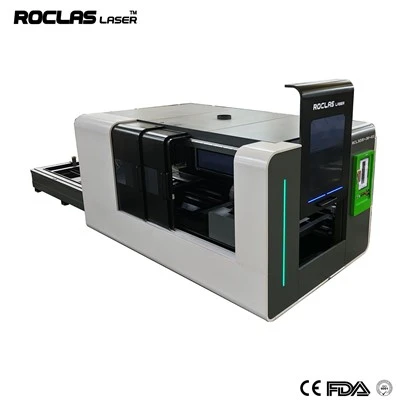
The inner and outer optical cores of the fiber laser cutting machine
The fiber laser cutting machine generates laser through the internal optical system and transmits and focuses the laser on the external optical system to achieve efficient cutting of materials, and its core principles and structural functions are as follows:
Internal optics: laser generation and heat control
- Cutting principle: The laser generator releases a high-density laser beam, irradiates the metal plate to melt or vaporize instantly, and then uses high-pressure gas to blow away the melt and residue, and completes the cutting and cutting through X, Y, and Z three-axis linkage.
- Laser generation: Electrical energy is converted into light energy, and the electro-optical conversion rate is 25%-35%, the higher the conversion rate, the lower the energy consumption, and the better the performance.
- Heat treatment: Heat energy will be generated during the energy conversion process, and if it is retained, it will damage the laser components, and the heat needs to be taken away through the chiller.
External optics: laser transmission, focusing and protection
- Light transmission: The laser is transmitted to the laser head through the optical fiber, and there is energy loss due to the diffusion of light during the transmission process, and it is wavy when released.
- Waveform light processing: The wavy light is processed into near-parallel light through a collimating mirror, which facilitates subsequent energy concentration.
- Focusing effect: The focusing lens collects almost parallel light and concentrates to form a high-density light spot to ensure the cutting energy.
- Protective lens: isolate metal dust and debris generated by cutting, avoid damage to the cutting head, it is a consumable product, and the average monthly loss is about 1 piece (depending on the intensity of use and the scene).
- Laser copper nozzle: the final release of the laser, which is also a consumable, has an average loss of about 2 per month (varies with the intensity of use and the scene).